
Medicare Part D11 min read
Arizona Medicare Plan Comparison: Find Your Best Fit
Use a Medicare plan comparison to match Arizona coverage to doctors, prescriptions, budget, travel, and 2027 enrollment dates—with free guidance.
Read the articleUnderstand Medicare Part D changes in 2026, including the $2,100 out-of-pocket cap, negotiated drug prices, and practical plan comparison steps.

For Arizona residents, Medicare Part D changes 2026 include a $2,100 annual limit on out-of-pocket costs for covered prescription drugs, plus Medicare-negotiated prices for certain drugs. Csginsurancepros helps you compare each plan’s formulary, pharmacy network, deductible, and monthly premium against the medications you actually take.
Medicare Part D changes 2026 mean you cannot pay more than $2,100 in qualifying out-of-pocket costs for Part D-covered drugs during one calendar year, although your premium and non-covered medicines remain separate expenses.
The cap resets every January 1. It is not a lifetime limit, and it does not apply across several years of coverage. Before you reach the limit, you pay the deductible, copayments, or coinsurance required by your specific plan. After your qualifying out-of-pocket costs reach $2,100, you pay nothing for additional covered Part D prescriptions for the rest of that calendar year.
A Part D formulary is the plan’s official list of covered prescription drugs. A drug must be covered by your plan and processed through the plan benefit for its cost sharing to count toward the Part D out-of-pocket limit. Your plan’s records, not a collection of pharmacy receipts, track your progress toward the cap.
The cap does not include:
That distinction matters. A person taking a high-cost self-administered specialty drug may reach the cap. A person receiving an infused medication in a clinic may have cost sharing under Part B instead. Those are different benefits and require different planning.
The standard Part D deductible can be as high as $615 in 2026. Some plans set a lower deductible, waive it for certain tiers, or use different copay structures. After any deductible, the standard benefit generally uses 25% coinsurance until the out-of-pocket threshold, but individual plan designs can offer different cost sharing. Do not choose a plan based on the deductible alone. The drug tier, pharmacy price, utilization rules, and premium can change your total cost far more.
The $2,100 Part D cap works by ending your cost sharing for covered Part D drugs once the plan’s out-of-pocket tracking reaches the annual threshold.
Consider a simplified example. You fill a covered medication in January and pay your plan’s deductible. Later fills require coinsurance. Each qualifying amount is recorded by the plan. If your costs accumulate to the annual threshold in September, you owe no additional deductible, copayment, or coinsurance for covered Part D medicines from that point through December 31.
You do not need to take the same drug all year for the cap to apply. Qualifying costs from covered Part D medications generally accumulate together within the same plan benefit. If you switch Part D plans during a qualifying enrollment period, ask how prior out-of-pocket costs are handled before assuming the new plan will show the same total immediately.
The cap protects you from unlimited cost sharing. It does not make every prescription inexpensive at the pharmacy counter early in the year. A plan with a high deductible can still create a difficult January or February bill, especially for an expensive brand-name drug. That is where the Medicare Prescription Payment Plan may help with timing.
The Medicare Prescription Payment Plan is an optional monthly payment arrangement offered by Part D plans and Medicare Advantage plans with drug coverage. It lets you spread your out-of-pocket prescription costs across monthly bills instead of paying the full amount at the pharmacy counter.
There is no additional fee or interest for using the payment option. It also does not reduce the plan’s negotiated drug price, lower your total cost sharing, or change the $2,100 cap. It changes when you pay.
If you elect the payment option, the plan pays the pharmacy its required share and then sends you a monthly bill based on your costs and the months left in the calendar year. The cost sharing is credited toward your out-of-pocket tracking when the prescription is processed. You do not have to finish every monthly installment before you can reach the cap.
The payment option is most useful if you have a predictable, high-cost prescription early in the year and need a smoother monthly budget. It may be less useful if you take only low-cost generics or can comfortably pay ordinary copays as you go. Enrolling late in the year can also create higher monthly bills because fewer months remain to spread the balance.
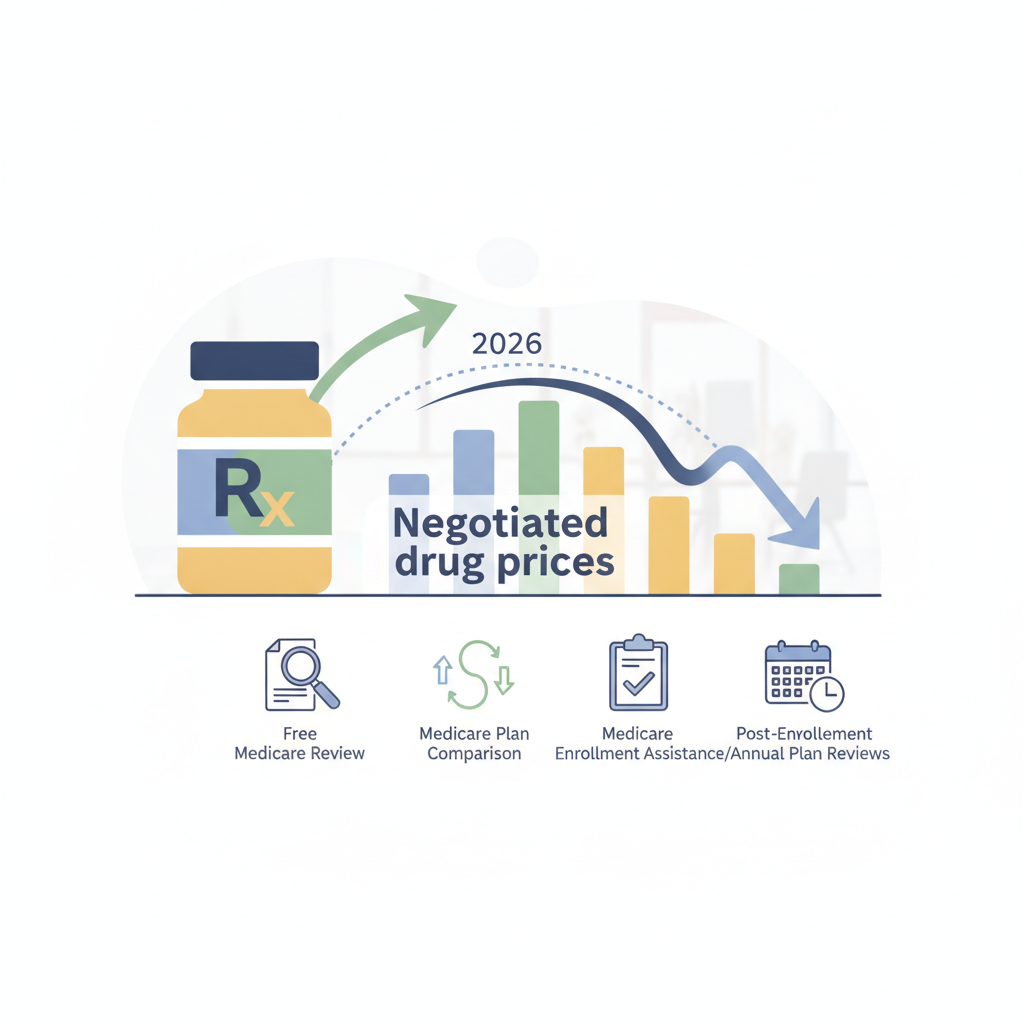
Medicare Part D changes in 2026 can affect your costs because certain selected drugs have Medicare-negotiated prices, while every Part D plan also uses its own negotiated pharmacy prices to calculate your share of the cost.
These are related but different concepts:
For a selected drug, a lower underlying price can reduce a percentage-based coinsurance amount and may slow how quickly you reach the annual cap. It does not guarantee that every member will see the same dollar reduction at the counter. Your result still depends on your plan’s formulary tier, whether you pay a flat copay or coinsurance, the pharmacy you use, and whether you have met the deductible.
For example, a drug on a specialty tier often has percentage-based coinsurance. Its negotiated price matters directly because your share is a percentage of that price. A drug with a fixed $35 copay may have a lower negotiated price behind the scenes without changing your immediate copay. Both situations can still affect the plan’s overall benefit economics, but your personal comparison should begin with the amount you will actually pay at your preferred pharmacy.
Never assume a drug is covered simply because it has a Medicare-negotiated price or because it was covered last year. Check the 2026 formulary, tier, restriction notices, and network pharmacy price before enrolling.
You should compare Part D plans by running your exact medication list through each available plan, then measuring your projected annual total cost at pharmacies you are willing to use.
Start with a current list from your prescription bottles or pharmacy profile. Include the exact drug name, strength, form, dosage, and how often you refill it. “Metformin” is not enough if one option is extended-release and another is immediate-release. Brand and generic versions can be treated differently. Insulin products, inhalers, specialty medicines, and drugs with limited generic availability deserve extra attention.
Then check each candidate plan for the factors below.
| What to compare | What to verify | Why it matters | Best use case | |---|---|---|---| | Formulary coverage | Drug name, dosage form, and tier | A plan cannot be your best value if your needed drug is excluded or placed on a costly tier | Every enrollee, especially people taking brand-name drugs | | Deductible | Whether it applies to all tiers or is waived for some drugs | A lower premium can come with a deductible that creates high early-year costs | People with expensive prescriptions filled in January | | Copay or coinsurance | Flat dollar amount versus a percentage of price | Coinsurance can produce larger and less predictable bills for high-cost drugs | Specialty, oncology, autoimmune, and other costly therapies | | Preferred pharmacy network | Your Arizona pharmacy and any mail-order option | A preferred network pharmacy can have materially lower plan cost sharing than a standard network pharmacy | Anyone loyal to a local pharmacy or using seasonal travel locations | | Utilization management | Prior authorization, step therapy, and quantity limits | Coverage may require plan approval, trying another drug first, or a limited fill amount | People taking newer, specialty, or tightly managed medications | | Monthly premium | Premium plus estimated drug spending for the full year | The lowest premium is not automatically the lowest annual cost | People comparing several plans with similar coverage | | Payment option | Whether monthly spreading would help your cash flow | It can prevent a large pharmacy-counter bill without changing the total cost | People facing large early-year Part D expenses |
A strong comparison looks at annual cost, not only the first fill. Add projected premiums to expected deductible and cost sharing. Then test at least two pharmacies if you are open to changing locations. The plan that is cheapest at one pharmacy may not be cheapest at another.
For Arizona residents, also confirm that the plan serves your county and that the pharmacy is in-network at the location you will actually use. If you spend part of the year elsewhere, check a pharmacy near that residence as well. Mail-order pricing can be useful for stable maintenance drugs, but it may not suit medications with frequent dosage changes, urgent refill needs, or special handling requirements.
Choose a standalone Part D plan if you have Original Medicare with a Medicare Supplement policy, and compare Medicare Advantage plans with drug coverage if you want medical and prescription coverage in one plan.
A Medicare Supplement, also called Medigap, generally does not include outpatient prescription drug coverage. Most people with Original Medicare and a Medigap policy who want drug coverage need a separate standalone Part D plan.
Many Medicare Advantage plans include Part D coverage; these are commonly called Medicare Advantage Prescription Drug plans. Their drug coverage must be evaluated alongside the plan’s medical provider network, copays, referral rules, and maximum out-of-pocket protection for medical services. A low drug premium does not make an Advantage plan a good choice if your doctors, hospitals, or medical needs do not fit the plan.
You usually cannot enroll in a standalone Part D plan while enrolled in a Medicare Advantage plan that already includes prescription drug coverage. Doing so can cause problems with your Medicare Advantage enrollment. Confirm the structure of any plan before making a change.
The Annual Enrollment Period generally runs from October 15 through December 7, with coverage changes effective January 1. Certain life events and coverage changes can create a Special Enrollment Period outside that window. Plan rules and drug lists can change each year, so reviewing your coverage annually is practical protection, not unnecessary paperwork.
Csginsurancepros can review your medication list, preferred Arizona pharmacies, Medicare coverage arrangement, and budget priorities at no cost. Contact csginsurancepros.com — Csginsurancepros — 2151 E Baseline Rd Ste 101, Tempe, AZ 85283 — (928) 263-8500 to speak with a licensed Arizona agent before you enroll or change plans.
Related services:
The following answers explain the $2,100 Part D limit, negotiated drug prices, and practical plan-selection issues for 2026.
No. The $2,100 annual limit applies to qualifying out-of-pocket costs for covered Part D prescription drugs, not to your monthly plan premium. It also does not include costs for non-covered drugs or most Part B medications.
No. The $2,100 amount is a maximum annual out-of-pocket limit for covered Part D drugs, not a required amount. Many people will spend less because they use lower-cost drugs, have lower plan cost sharing, or do not reach the threshold.
Not always. A Medicare-negotiated price can lower the underlying cost of a selected drug, but your pharmacy payment still depends on your plan’s tier, deductible, copay or coinsurance design, and pharmacy network status.
After your qualifying Part D out-of-pocket costs reach $2,100 in 2026, you pay no further deductible, copayments, or coinsurance for covered Part D drugs for the remainder of that calendar year. Your monthly premium still continues.
No. The Medicare Prescription Payment Plan spreads qualifying out-of-pocket drug costs into monthly payments and does not reduce your total drug cost, premium, or Part D deductible. It can help you manage a large pharmacy bill early in the year.
Bring each medication’s exact name, strength, form, dosage, refill frequency, and preferred pharmacies, along with your current Medicare coverage details. That information allows a licensed agent to compare formularies, restrictions, pharmacy pricing, premiums, and projected annual costs accurately.
---
[Aaron C. Matheny](https://www.linkedin.com/in/aaron-matheny-673a4bb) — Owner / Agency Manager
Licensed Medicare Broker · Owner / Agency Manager
A licensed CSG agent can compare plan options from the carriers CSG represents that are available in your Arizona ZIP code and explain the trade-offs in plain language. CSG does not charge a separate client fee for that help.
Published by
Aaron C. Matheny
General Medicare information published by CSG Insurance Pros. For guidance about your circumstances, speak directly with a licensed agent.
Meet the teamUse a Medicare plan comparison to match Arizona coverage to doctors, prescriptions, budget, travel, and 2027 enrollment dates—with free guidance.
Read the articleHybrid life long-term care insurance can protect care savings and leave a death benefit. Compare costs, monthly benefits, and policy fit in Arizona.
Read the articleWhether to use a Medicare agent or enroll direct, what an independent broker actually does, how agents get paid, and the questions to ask before you pick one in Arizona.
Read the article